Financial News: Discrete auction held for SVET securities

Translation. Region: Russian Federal

Source: Moscow Exchange – Moscow Exchange –

An important disclaimer is at the bottom of this article.

LIGHT

Traffic light

As of 10:55:00 the current price was 20.3 rubles. (Deviation – 21.32%).

There was a decrease of 20.00% or more within 5 consecutive minutes in the current share price from the closing price of the previous trading day (25.8 rubles).

In the Main Trading Mode T, a discrete auction (DA) will be held from 10:59:00.

In other non-addressed trading modes during the DA period, trading is conducted in accordance with the established regulations.

End of DA and resumption of trading at 11:29:00.

Please note: This information is raw content obtained directly from the source of the information. It is an accurate report of what the source claims and does not necessarily reflect the position of MIL-OSI or its clients.

.

Financial News: Discrete auction held for SVETP securities

Translation. Region: Russian Federal

Source: Moscow Exchange – Moscow Exchange –

An important disclaimer is at the bottom of this article.

Svetp

Traffic light p

As of 10:59:00 the current price was 40.3 rubles. (Deviation – 21.67%).

There was a decrease of 20.00% or more within 5 consecutive minutes in the current share price from the closing price of the previous trading day (51.45 rubles).

In the Main Trading Mode T, a discrete auction (DA) will be held from 11:03:00.

In other non-addressed trading modes during the DA period, trading is conducted in accordance with the established regulations.

End of DA and resumption of trading at 11:33:00.

Please note: This information is raw content obtained directly from the source of the information. It is an accurate report of what the source claims and does not necessarily reflect the position of MIL-OSI or its clients.

.
Financial news: 08/25/2025, 10-12 (Moscow time) the values of the upper limit of the price corridor and the range of market risk assessment for the RU000A10BT34 (Rosset1P17) security were changed.

Translation. Region: Russian Federal

Source: Moscow Exchange – Moscow Exchange –

An important disclaimer is at the bottom of this article.

08/25/2025 10:12

In accordance with the Methodology for determining the risk parameters of the stock market and the deposit market of PJSC Moscow Exchange by NCO NCC (JSC), on August 25, 2025, 10-12 (Moscow time), the values of the upper limit of the price corridor (up to 112.81) and the range of market risk assessment (up to 1188.97 rubles, equivalent to a rate of 13.75%) of the security RU000A10BT34 (Rosset1P17) were changed

Please note: This information is raw content obtained directly from the source of the information. It is an accurate report of what the source claims and does not necessarily reflect the position of MIL-OSI or its clients.

.

Moscow Metro – 17 Foreign Megacities Become New Participants in the UrbanTransportData Project

Translation. Region: Russian Federal

Source: Moscow Metro

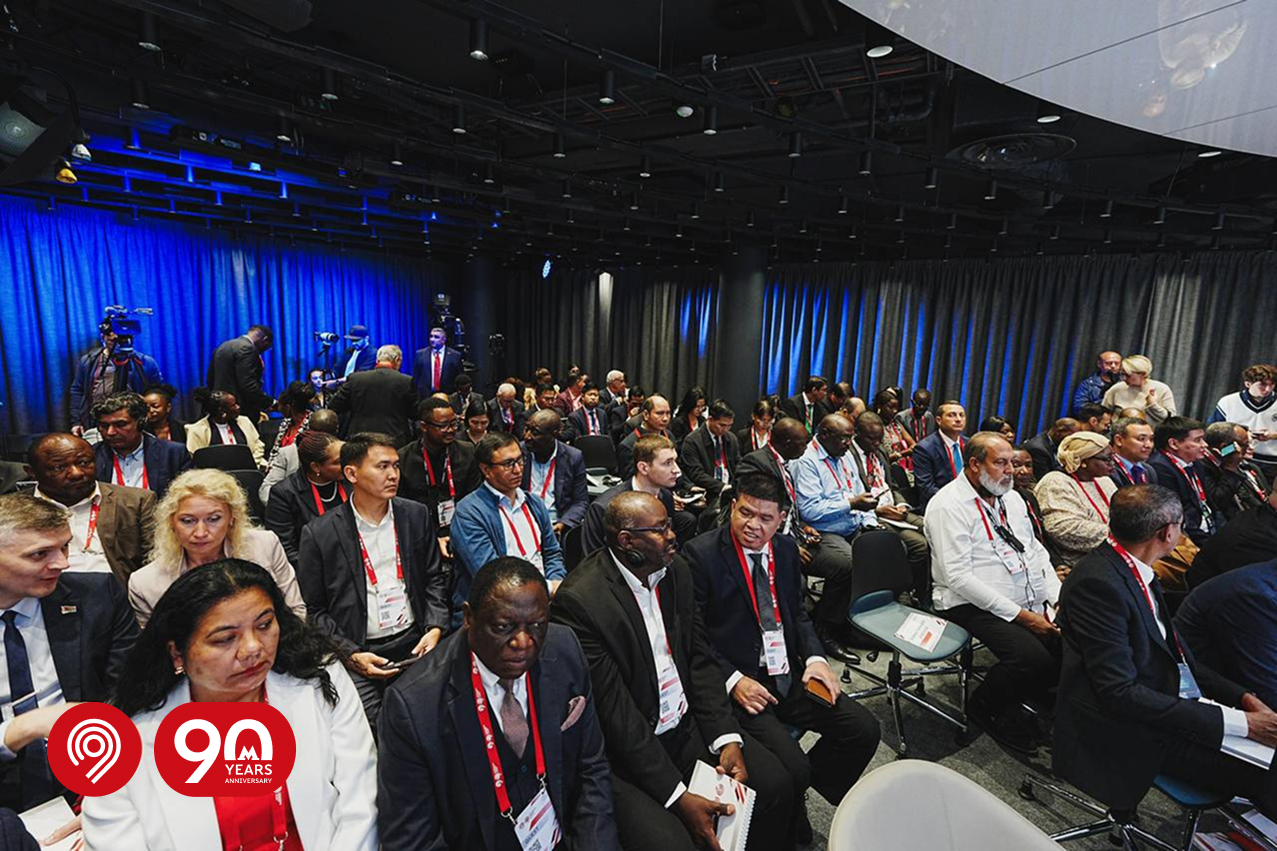
The IV International Transport Summit has started in Moscow; this year it brought together more than 140 experts from 41 cities around the world.


Moscow Metro – 17 foreign megacities have become new participants in the UrbanTransportData project.

On the opening day, 17 more cities joined the Moscow Government's international project UrbanTransportData. Joint statements of cooperation for joining were signed by Addis Ababa, Almaty, Astana, Banjul, Freetown, Havana, Harare, Ho Chi Minh City, Kampala, Lilongwe, Lima, Lusaka, Maputo, Mexico City, Nairobi, Windhoek and Yerevan.

UrbanTransportData is an analytical platform that allows you to obtain information on transport indicators in different cities around the world and get acquainted with best practices and industry trends.

"At the request of Moscow Mayor Sergei Sobyanin, we continue to develop the UrbanTransportData project. Today, within the framework of the International Transport Summit, 17 more cities from Africa, Latin America, Asia and the CIS joined the initiative. Now 32 megacities of the world are participating in the project. Our analytical platform includes a professional forum for experts in the field of urban transport and an extensive knowledge base for civil servants, specialists, students and researchers," said Deputy Mayor of Moscow for Transport and Industry Maxim Liksutov.

In addition, on the first day of the business program, memorandums of cooperation in the field of transport were signed between the Government of Moscow and the People's Government of Beijing, as well as the Government of Moscow and the Bangkok Administration.

As part of the summit, participants will discuss industrial development and integration of advanced technologies into urban transport, passenger digital services and ticketing systems, unmanned technologies, rail, water, alternative transport and much more at round tables.

Foreign guests will get acquainted with the work of regular river electric transport and charging infrastructure, visit the Unified Dispatch Center of the Moscow Metro, BKL, MCD, electric bus depot, TsODD situation center, the Center for Research and Development of Unmanned Transport, as well as the sites of the Technopolis Moscow SEZ.

The cultural program of the summit was prepared by the Moscow Transport Museum. Participants will visit the exhibition "High Underground" dedicated to art in the Moscow metro, and then go to VDNKh in retro cars, where guests will have a tour of the exhibition "You look 100!" about the history of domestic transport design. The program will end at the Northern River Terminal. Foreign delegates will also visit the large-scale interactive exhibition "That Same Moscow" in the Manezh Central Exhibition Hall.

The day of the defeat of German troops by Soviet troops in the Battle of Kursk

Translation. Region: Russian Federal

Source: Official website of the State –

An important disclaimer is at the bottom of this article.

On August 23, our country celebrates the Day of the defeat of German troops by Soviet troops in the Battle of Kursk.

The Battle of Kursk is one of the largest and most strategically important battles of the Great Patriotic War. It took place in the summer of 1943 between the Red Army and the Wehrmacht and lasted 50 days. The battle was of great importance for the outcome of the entire war and became a turning point that finally confirmed the superiority of the Soviet Union over Germany. It is no coincidence that this date was included in the list of Days of Military Glory of Russia.

In developing Operation Citadel, the German command sought to regain the initiative by attacking the salient of the front in the Kursk region, hoping to encircle the Soviet troops and deliver a crushing blow. In response, the Russians created a deeply echeloned system of fortifications. Therefore, the Battle of Kursk can be divided into two stages: defensive and offensive. Germany concentrated about 900 thousand soldiers, about 10 thousand artillery pieces, 2758 tanks and 2050 aircraft for the attack. 1.3 million Soviet soldiers prepared to defend their native land with the support of more than 19 thousand guns and mortars, 3444 tanks and 2172 aircraft.

The Nazi troops advanced on July 5. The Red Army steadfastly withstood the onslaught and, thanks to operational intelligence, even launched counterattacks. One of these was the famous battle near the village of Prokhorovka – the largest tank counter battle in world history, where our units clashed with the elite German divisions “Adolf Hitler”, “Reich” and “Death's Head”.

Soviet offensive operations began on July 17, when the enemy's pressure had not yet died down, so dividing the Battle of Kursk into stages is arbitrary. By the 23rd, the Russians had reached the positions of the fascist troops that they had occupied at the beginning of the battle, and then drove them westward.

The battle ended with the liberation of Orel, Belgorod and Kharkov. Kursk, Orel and Belgorod became the first cities to receive the honorary title of "City of Military Glory".

The German army lost not only the captured lands, about 500 thousand killed, wounded and captured soldiers, 1,500 tanks and 3,700 aircraft, but also the strategic offensive initiative.

The victory in the Battle of Kursk marked the beginning of the Red Army's liberation campaign into occupied Europe.

Among the participants in the turning point battle were several employees of the State University of Management, including two Heroes of the Soviet Union, Mikhail Gureev and Pyotr Sedelnikov. The first commanded a mortar regiment and was awarded the Order of the Patriotic War, 2nd degree, for his successful actions. The second, as part of the 237th Assault Aviation Regiment, received his baptism of fire in the skies over Kursk.

GUU congratulates everyone on this significant day. Glory to our heroic ancestors who defended the fatherland! And glory to their descendants who recently once again drove out the invaders from the Kursk land.

Subscribe to the TG channel “Our GUU” Date of publication: 08/23/2025

Please note: This information is raw content obtained directly from the source of the information. It is an accurate report of what the source claims and does not necessarily reflect the position of MIL-OSI or its clients.

.

Financial News: Information on the acquisition of shares of Solidcore Resources plc (POLY).

Translation. Region: Russian Federal

Source: Moscow Exchange – Moscow Exchange –

An important disclaimer is at the bottom of this article.

Name of the Issuer; Solidcore Resources plc.

Name of security; Ordinary shares.

Identification/registration number of the issue – Security code; POLYISIN code JE00B6T5S470.

Buyer; Buyer's identifier in the clearing system is MC0356400000.

Lot size: 1 Share.

Purchase price; 2.57 (Two dollars fifty-seven cents) in rubles at the exchange rate of the Bank of Russia set on the first day of the relevant period for collecting proposals, rounded to two digits.

First period of collecting proposals

The start date for collecting proposals is 25.08.2025.

The deadline for collecting proposals is 28.08.2025.

Date of activation and conclusion of over-the-counter agreements within the first period of collecting proposals; 08/29/2025.

Second period for collecting proposals

Start date for collecting proposals: 01.09.2025.

The deadline for collecting proposals is 04.09.2025.

Date of activation and conclusion of over-the-counter agreements within the second period of collecting proposals; 05.09.2025.

Third period of collecting proposals

The start date for collecting proposals is 09/15/2025.

The deadline for collecting proposals is 18.09.2025.

Date of activation and conclusion of over-the-counter agreements within the third period of collecting proposals; 19.09.2025.

Fourth period of collecting proposals

The start date for collecting proposals is 09/22/2025.

The deadline for collecting proposals is 09/25/2025.

Date of activation and conclusion of over-the-counter agreements within the fourth period of collecting proposals; 09/26/2025.

Fifth period of collecting proposals

Start date for collecting proposals: 06.10.2025.

The deadline for collecting proposals is 09.10.2025.

Date of activation and conclusion of over-the-counter agreements within the fifth period of collection of proposals; 10.10.2025.

Sixth period of collecting proposals

The start date for collecting proposals is 13.10.2025.

Closing date for proposals: 16.10.2025.

Date of activation and conclusion of over-the-counter agreements within the framework of the sixth period of collection of proposals; 17.10.25.

Information on the terms of acquisition (Mode, redemption form); With preliminary collection of offers with the activation date in the mode of concluding over-the-counter transactions “Redemption: Address transactions”. (Settlements: Ruble, mode code – MPBB).

Acceptable types of sentences

Price Quantity: indicating the Purchase Price of Shares, corresponding to the above, and the number of securities in lots (the maximum number of securities that the potential seller would like to sell)

Settlement code T0

Submission of offers on the terms “Partial collateral/compensation” (possible only if the Trade and Clearing Account T is indicated in the offer): No.

Time for collecting proposals during the proposal collection period: from

10:00 – 19:00 – 25.08.25 to 28.08.25 from 10:00 – 19:00 – 01.09.25 to 04.09.25 from 10:00 – 19:00 – 15.09.25 to 18.09.25 from 10:00 – 19:00 – 09/22/25 to 09/25/25 from 10:00 – 19:00 – 10/06/25 to 10/09/25 from 10:00 – 19:00 – 10/13/25 to 10/16/25

Time of control and blocking of partial security (pre-activation); Not carried out.

Partial Security Amount – Compensation Amount – Offer Activation Time:

I: 35 – 08/29/259: 35 – 05.09.259: 35 – 19.09.259: 35 – 09/26/259: 35 – 10.10.259: 35 – 17.10.25

Time of the period for satisfying offers:

9:50 – 16:00 – 08/29/259: 50 – 16:00 – 05.09.259: 50 – 16:00 – 19.09.259: 50 – 16:00 – 09/26/259: 50 – 16:00 – 10.10.259: 50 – 16:00 – 17.10.25

Rejection by the Seller of offers that are not subject to satisfaction: before 16:00 – 29.08.25before 16:00 – 05.09.25before 16:00 – 19.09.25before 16:00 – 26.09.25before 16:00 – 10.10.25before 16:00 – 17.10.25

Please note: This information is raw content obtained directly from the source of the information. It is an accurate report of what the source claims and does not necessarily reflect the position of MIL-OSI or its clients.

Financial news: On additional conditions for trading in corporate bonds 36 LLC "SFO BCS Structural Notes"

Translation. Region: Russian Federal

Source: Moscow Exchange – Moscow Exchange –

An important disclaimer is at the bottom of this article.

For bidders

We inform you that in accordance with Part I. General Part of the Rules for Conducting Trading on the Stock Market, Deposit Market and Credit Market of PJSC Moscow Exchange MICEX-RTS, approved by the decision of the Supervisory Board of PJSC Moscow Exchange on February 7, 2025 (Minutes No. 16), and in connection with the receipt of a letter from SFO BCS Structured Notes LLC on the possibility of the occurrence of Special Barrier Events on the specified dates for structured uncertificated bonds of series 36, interest-bearing, discounted, non-convertible, with collateral, intended for qualified investors of SFO BCS Structured Notes LLC (ISIN – RU000A108Q37) (hereinafter referred to as the Bonds),

it has been established that, from August 25, 2025, line of Table 1-O (Bonds T) “Trading modes available for bonds and CSUs when concluding transactions in the Stock Market Section and the REPO Market Section” of the appendix to the Additional terms and conditions for conducting trading on the stock market, approved by Orders No. MB-P-2025-2070 dated June 6, 2025, No. MB-P-2025-2157 dated June 16, 2025 and No. MB-P-2025-2672 dated July 17, 2025 (as amended and supplemented), shall be amended as follows:

№p/p Trade code Name Registration number Conducting trades Peculiarities
“Main Trading Mode T” "RPS with the Central Committee" “REPO with CC – Addressed orders” “REPO with CC – Non-addressed orders” Negotiated deal mode “Interdealer REPO”
Acceptable settlement codes for individual trading modes
Y1 Y0-y7 T0/yn*, y0/yn*, y1/yn*, y2/yn* Y0/Y1, Y0/Y1W T0,B0-B30,Z0 S0s2, Rb, Z0
1 RU000A108Q37 Corporate bond 36 LLC "SFO BCS Structured Notes" 6-36-00508-R from 10.06.2024 Rub Rub Rub, CNYKZT, BYN Rubcny RUB RUB, CNYKZT, BYN 1; Accrued income tax is not calculated; From 25.08.2025, settlement codes that provide for the execution of transactions no later than 25.02.2026 are permissible.

*-the value “n” is defined as follows: HTTPS: //FS. MOEX.K.M.O.fles/20211

1 – Trading is not conducted on the bond maturity date.

Contact information for media 7 (495) 363-3232Pr@moex.kom

Please note: This information is raw content obtained directly from the source of the information. It is an accurate report of what the source claims and does not necessarily reflect the position of MIL-OSI or its clients.

Financial news: 08/25/2025 JSC “SME Corporation” will hold a deposit auction.

Translation. Region: Russian Federal

Source: Moscow Exchange – Moscow Exchange –

An important disclaimer is at the bottom of this article.

Parameters;

Date of the deposit auction 08/25/2025. Placement currency RUB. Maximum amount of funds placed (in the placement currency) 469,000,000. Placement term, days 62. Date of depositing funds 08/27/2025. Date of return of funds 10/28/2025. Minimum placement interest rate, % per annum 17. Terms of the conclusion, urgent or special (Urgent). Minimum amount of funds placed for one application (in the placement currency) 469,000,000. Maximum number of applications from one Participant, pcs. 1. Auction form, open or closed (Open).

The basis of the Agreement is the General Agreement. Schedule (Moscow time). Preliminary bids from 10:30 to 10:40. Competitive bids from 10:40 to 10:50. Setting the cutoff percentage or declaring the auction invalid before 11:30. Additional terms.

Please note: This information is raw content obtained directly from the source of the information. It is an accurate report of what the source claims and does not necessarily reflect the position of MIL-OSI or its clients.

Financial news: 08/22/2025, 15-31 (Moscow time) the values of the upper limit of the price corridor and the range of market risk assessment for the SU25085RMFS0 security (OFZ 25085) were changed.

Translation. Region: Russian Federal

Source: Moscow Exchange – Moscow Exchange –

An important disclaimer is at the bottom of this article.

08/22/2025

15:31

In accordance with the Methodology for determining the risk parameters of the stock market and deposit market of Moscow Exchange PJSC by NCO NCC (JSC), on August 22, 2025, 15:31 (Moscow time), the values of the upper limit of the price corridor (up to 103.97) and the range of market risk assessment (up to 1089.72 rubles, equivalent to a rate of 6.25%) of the SU25085RMFS0 security (OFZ 25085) were changed.

Please note: This information is raw content obtained directly from the source of the information. It is an accurate report of what the source claims and does not necessarily reflect the position of MIL-OSI or its clients.

how and when did the russian flag appear

Translation. Region: Russian Federal

Source: Peoples'Friendship University of Russia –

An important disclaimer is at the bottom of this article.

On August 22, Russia celebrates the Day of the National Flag. In honor of the holiday, we decided to talk to the head of the Russian History Department of the Faculty of Humanities and Social Sciences of RUDN Elena Kryazheva-Kartseva and find out when the tricolor appeared, who was its creator, and what other flags our country has had.

When did the very first flags appear and where?

There are many flags in the world today, both state and territorial, regional, city. There are also flags of military forces, international organizations, ships and even some private companies.

They are studied by scientists within the framework of an auxiliary historical discipline – vexillology (from the Latin vexillum – banner), where they study the history of the formation and development of the so-called banner material (banners, flags, standards, banners, banners, curtains, ensigns, pennants, guises, weather vanes, bunchuks, etc.), as well as staffs, rods, scepters and various signs that are worn on the pole. In recent years, flags have been most actively studied, as they represent symbols of state sovereignty. Along with the coat of arms and the anthem, they are a conscious embodiment of the unity of the meanings of civilization.

Speaking about the appearance of the first flags in the world, scientists point to the countries of the Ancient East (banners with the emblem of the Sumerian god Nanna (3rd millennium BC), the white flag of the Chinese Zhou dynasty (11th–3rd centuries BC), Indian flags with images of totem animals and birds.

Speaking about the history of Russia, the word banner was first mentioned in the Tale of Bygone Years in 1096. However, in the 11th century, a banner was understood as a military unit, and only since the 12th century, a banner increasingly began to mean a flag, and not a military unit. The following expressions are found in the chronicles: “having thrown the banner and run”, “holding Yaropolk’s banner”, “raising the banner”, “they see that his banner is raised up”. The standard-bearer was called a “banner bearer”. At the same time as the banner, a gonfalon began to be mentioned in the meaning of a flag. A gonfalon is a church banner (a portable icon). Its main feature is the way the cloth is attached – its upper part is attached to a horizontal crossbar, which is fixed crosswise on a vertical pole. Since the 14th century, images of Jesus Christ began to be placed on banners. Such banners began to be called banners. In the Battle of Kulikovo, the banner of Dmitry Donskoy was crimson. With the same banner, crimson, Tsar Ivan IV the Terrible went on a campaign against Kazan in 1552.

Where should we look for the earliest roots of the Russian tricolor?

The prototype of the modern flag appeared in Russia at the end of the 17th century under Tsar Alexei Mikhailovich. The first Russian military ship "Orel", built in the village of Dedinovo in the Kolomensky district, was equipped with a white-blue-red banner, the exact order of the mutual arrangement of the stripes is unknown. In the center was an image of a gold (yellow) double-headed eagle. The ship was intended to protect Russian merchant ships on the Caspian Sea. Sources indicate that red, blue and white fabric was used in the manufacture of the flag of the first Russian ship. However, the white-blue-red flag of Alexei Mikhailovich was not similar to what we have today. The creator of the tricolor as it exists in modern Russia was Peter I.

The future Emperor Peter I in 1693 during a trip to Arkhangelsk saw that all foreign ships sailed under the flags of either the country, or the home port, or a trading company. The future Emperor also saw the color diversity of flags and was familiar with the tricolor variant. The first tricolor appeared in the Netherlands during the War of the Seventeen Provinces for their independence in the 16th century. It was a cloth of horizontally arranged orange, white and blue stripes – the heraldic colors of Prince William of Orange.

That is why Peter I, who was keen on maritime affairs and shipbuilding, ordered that Russian ships should fly either "cross" or "striped" flags, the color scheme of which should be white-blue-red. Peter the Great personally worked on developing the image of the flag with the sequence of white-blue-red stripes that we are accustomed to.

Thus, on August 6, 1693, a tricolor with a golden double-headed eagle was established as a symbol of the state. Peter I had such a flag during his voyage across the White Sea. This is the first example that has come down to us – the so-called "flag of the Moscow Tsar" Peter I, which was raised on the ship "Saint Peter" in 1693. It was from Peter's time that the combination (from top to bottom) of white, blue (light blue) and red stripes was established. On the one hand, the appearance of the white-blue-red flag is associated with the development of the fleet, on the other hand, it is a sign of the construction and strengthening of the state. During the Battle of Narva, a significant part of Peter's troops fought under tricolor banners with a double-headed eagle. A large number of these banners fell into the hands of the Swedes after the defeat at Narva, thanks to which it is known exactly what they looked like.

How has the country's national flag changed throughout its history?

What prompted Peter to abandon the widespread use of the white-blue-red banner and flags created on its basis is unknown. But this is exactly what happened in 1720. The "St. Andrew's flag" was established as the naval flag of Russia – a white flag with a blue oblique cross. A yellow cloth with a black double-headed eagle in the center began to be used as the royal standard. The white-blue-red flag remained exclusively a commercial flag from 1720.

The State Flag of Russia was approved by Alexander II on June 11, 1958, and it was a black and white-yellow flag, which correlated with the emblem of Russia-the Black State Eagle in a yellow or golden field. However, at the conclusion of the Parisian world, Alexander II, the French capital was decorated with a white-blue-red flag. And in the future, white-blue-red banners often adorned the cities of Russia. For example, at the opening of the monument to A.S. Pushkin in 1880, the opening of the monument to the Grenadiers who fell under the Plevna (1887). Around the 1870s, the simultaneous existence of two flags in the country was not noticeable, since the buildings were decorated during the holidays with carpets, garlands and other attributes. But at the end of the 19th century, it became clear that it was necessary to make a decision, which flag is folk. That is why Emperor Nicholas II gathered a special meeting twice, which came to the conclusion that the white-blue-red flag was perceived by the people. In April 1896, at the direction of Emperor Nicholas II, the only Russian state flag was declared white-blue-red. In April 1918, at a meeting of the All-Russian Central Executive Committee, a new state flag was approved. The Decree of the All -Russian Central Executive Committee read: “The flag of the Russian Republic establishes a red banner with the inscription“ Russian Federal Republic ”. On the model of the flag of the RSFSR, state flags of other Soviet republics were subsequently established. In 1922, the Union of Soviet Socialist Republics was formed. The first official description of the flag of the Soviet Union is found in the 1924 Constitution. The state flag of the USSR over the years of the existence of the Soviet state was modified slightly. The following description was given in the 1936 Constitution: “The flag consists of a red panel with an image on its upper corner, near the pole, gold sickle and hammer and a red five -pointed star framed by a golden border above them. The ratio of the width to the length is 1: 2 ”.

Since August 22, 1991, the tricolor flag has once again become the State Flag of the Russian Federation. However, the color scheme was not established immediately. After the events of August 1991, the flag was white-azure-scarlet. And only on December 11, 1993, the day before the referendum on the new constitution, the flag of the Russian Federation was changed by presidential decree from white-azure-scarlet to white-blue-red.

In 1994, a holiday was established – Day of the State Flag of the Russian Federation. Since then, it has been celebrated annually on August 22.

What do the colors of the Russian tricolor symbolize? Is there an officially approved interpretation of the colors of the flag?

The white-blue-red flag is a symbol of the Russian Federation. However, its history is still controversial, especially the interpretation of its color scheme. There is no official "explanation" of the colors of the national flag in the laws. Therefore, to interpret them, we turn to public attitudes and the conclusions of experts in different historical eras.

According to Russian "everyday" concepts of the 17th-18th centuries, red symbolized courage, war, protection of faith and poor people, heroism, generosity, blood, self-sacrifice, fire, mortal combat, the power of the state. Blue – the sky, chastity, fidelity, the Virgin Mary, spirituality, faith. White – "incorruptible perfection", peace, purity, truth, freedom, nobility, innocence. The arrangement of the stripes reflects the ancient idea of the structure of the world: below – the physical, then – the heavenly world, at the top – the divine world. Many supporters of the white-blue-red banner explained the symbolism of its colors with church images. For example, in the book by A. I. Uspensky, information is provided that the three colors indicated are sacred colors for the Russian Orthodox Church, and blue is considered the color of the Virgin Mary. There was also another popular interpretation of the white-blue-red flag, namely that the colors (from top to bottom) symbolize Faith, Hope and Love.

Due to numerous discussions about the symbolism of the colors of the flag, in the late 19th and early 20th centuries, Emperor Nicholas II twice convened a Special Conference "for a comprehensive and, if possible, final clarification of the issue of the state Russian national colors," which recognized the white-blue-red flag as the Russian national flag. The Special Conference noted that objectively the appearance of the flag is associated with the historical activities of Peter I. But the public recognition of the color scheme also contributed to the establishment of the flag as a national flag. On the pages of the materials of the Special Conference, we find an explanation of this phenomenon from the point of view of manifestations of folk life, as well as the nature of Russia. In particular, the following fact was noted: "A Great Russian peasant wears a red or blue shirt in the field and on holidays, a Little Russian and a Belarusian – in a white one, Russian women dress up in sarafans, also red and blue." It was emphasized that in the Russian language there are many proverbs and sayings where "respect for the white color is visible." Thus, in the opinion of the members of the Special Conference, such examples of the use of the said colours by the people were proof that for the "emblematic expression of the external appearance of Russia it is necessary to use the colours: white, blue and red". As a result of the work of the Special Conference, it was decided that the white-blue-red flag should be uniform for the entire Empire.

Although in the 21st century Russians no longer wear red shirts and sarafans to holidays, the colors of the flag are still close to public understanding. And that is why the most common interpretation of the colors of the flag is as follows: white means freedom, nobility, peace; blue – faith and spirituality; red symbolizes sovereignty, which has always been inherent in the Russian state and our multinational people.

Why was the white-azure-scarlet flag replaced by white-blue-red?

The replacement of the white-azure-scarlet flag with a white-blue-red one occurred in the process of standardizing state symbols. The terms "azure" and "scarlet" are poetic and less accurate in color designation. In 1991, the Extraordinary Session of the Supreme Soviet of the RSFSR decided to consider the pre-revolutionary tricolor as the official symbol of Russia. However, the color scheme was not established immediately. After the events of August (the Putsch), the state flag was white-azure-scarlet. And only on December 11, 1993, the day before the referendum on the new constitution, the flag of the Russian Federation was changed by presidential decree from white-azure-scarlet to white-blue-red. The use of the terms "blue" and "red" made it possible to unify the description of the flag's colors, simplify its production, and ensure uniformity of the state symbol in international perception.

Thus, the modern Russian tricolor is the result of a long historical development of state symbols; it reflects both ancient traditions and modern realities of our country.

Please note: This information is raw content obtained directly from the source of the information. It is an accurate report of what the source claims and does not necessarily reflect the position of MIL-OSI or its clients.

.