
Slavic Horizon 2025 at the Polytechnic: A Map of Future Collaboration

Translation. Region: Russian Federal

Source: Peter the Great St. Petersburg Polytechnic University –

An important disclaimer is at the bottom of this article.

The 3rd Slavic Universities Summit "Slavic Horizon 2025" was held at Peter the Great St. Petersburg Polytechnic University. The event brought together representatives of the Russian Ministry of Science and Higher Education, the heads and staff of four Slavic universities from Armenia, Belarus, Kyrgyzstan, and Tajikistan, as well as RUDN University and the Russian State University for the Humanities. Participants not only summarized the results of long-standing collaboration but also outlined concrete steps for creating a deeply integrated consortium.

"For the Polytechnic University, this isn't just an international project, it's the largest and most systemically important one. Over the past few years, we've held over 200 joint events, implementing around 20 major research areas and dozens of network programs," noted Dmitry Arsenyev, Vice-Rector for International Affairs at SPbPU. "Our goal is to create synergistic projects that will unite all members of this community."

The practical part of the first day of the summit included a unique masterclass on the computer simulator "Lean Office at the University." The simulator is a powerful tool for training management teams. For three hours, summit participants experienced a glimpse of university life in a virtual environment, where every mistake is a realization, and every decision is a step toward development.

The summit participants placed special emphasis on working with young people. Maxim Pasholikov, SPbPU Vice-Rector for Information, Youth Policy, and Security, invited colleagues to a session at the historic Hydrotower: "My students and I 'took over' this building from the rector's office about seven years ago, and now it's our unified center. We'll be happy not only to present our practices but also to absorb yours."

Discussions on youth policy and student initiatives demonstrated that this block is a powerful tool for integration. It was proposed to go beyond one-time visits and organize summer and winter schools at Slavic universities, bringing together students from several institutions. Specific initiatives included creating a youth camp at one of the national universities and holding the Universiade at the Russian Agrarian University (RAU) with an invitation to all partners. It was also suggested developing student brigades, reviving the practice of organizing work semesters where students from different countries work together at Russian or national enterprises, similar to Soviet construction brigades. In the area of sports and creativity, the idea was voiced of holding regular joint Spartakiads and festivals, which would facilitate informal student bonding.

At the "Youth Policy" session in the Hydrotower, Maxim Pasholikov presented to his colleagues the system for organizing youth and student activities at the Polytechnic University. He discussed our university's approaches to creating an environment for developing student initiatives, supporting talent, and engaging young people in university life. Then, in the "Workshop of Practices" format, the participating universities presented their best systemic projects in the "Media," "Adaptation," "Creativity," and "Sports" tracks, exchanged experiences, and discussed the possibilities of implementing these practices at their universities. Maxim Susorov, Chairman of the Students' Union, also delivered a report on "The Structure of Student Self-Government at SPbPU." The session helped identify common challenges and promising areas for cooperation and served as a platform for developing a unified database of proven youth policy solutions.

We are currently working on a new methodology for creating a development program that will take into account the unique characteristics and maximize the strengths of each Slavic university, emphasized Anna Kalabina, Head of the International Cooperation Department in Higher Education at the Department of State Policy in Higher Education at the Russian Ministry of Education and Science.

The "Education" session at the summit featured an exchange of best practices between representatives from Russia, Armenia, Belarus, Kyrgyzstan, and Tajikistan. The focus was on transforming university educational policies in the face of modern challenges and the drive toward technological leadership. Participants discussed the need to restructure the higher education system, combining the best elements of the Soviet system with the positive experiences of the Bologna Process. Particular emphasis was placed on the transition to single-cycle education, which ensures self-sufficient training of specialists without the need for additional master's degree programs, which is especially relevant for engineering fields. Vice-Rector for Academic Affairs Lyudmila Pankova presented examples of the launch of five-year programs developed by Polytechnic University in collaboration with industrial partners.

A key topic of discussion was the implementation of a system for individual student achievement in assessing educational outcomes. Participants shared their experiences in incorporating extracurricular activities, such as participation in Olympiads or completing projects for employers, into ongoing academic performance and state final certification. They discussed approaches to developing digital student portfolios, which will enable the recording and assessment of students' diverse achievements and competencies. Issues of increasing the flexibility of educational programs and their adaptation to rapidly changing labor market demands, including the integration of digital competencies and artificial intelligence, were also touched upon.

Furthermore, the summit focused on practice-oriented education and university networking. Colleagues from Slavic universities discussed the possibility of jointly developing and implementing educational modules to pool competencies and enhance synergies. They also considered strengthening the position of the Russian language and preserving a shared historical and cultural heritage through joint educational and outreach projects. Another area of discussion was the development of university teaching staff, including the introduction of new career paths for faculty and the organization of internships to enhance their practical experience. Participants expressed their willingness to further collaborate, replicate successful practices, and collaborate on projects aimed at modernizing the educational process.

An important initiative was the proposal to hold summits in turn at the sites of all Slavic universities.

The discussion participants agreed on the need to go beyond bilateral ties and implement multilateral network projects. Regarding network and joint programs, the problem of regulatory barriers to launching full-fledged network programs between international partners was highlighted. A proposed solution is to actively develop the format of joint modules, where a professor from one university teaches a course at another. The idea of creating a unified platform where industrial partners could post real-world problems, and students from participating universities would form inter-university teams to solve them and present their results online was also proposed.

Following the meeting, cooperation reached a new level. As Nikita Golovin, head of the Slavic Universities project office and deputy head of the SPbPU International Cooperation Office, aptly noted: "The true value of this summit lies in its working and informal nature, in the atmosphere of open and trusting dialogue. It is in this unconventional environment that the most breakthrough ideas are born. The summit becomes the place where not only the agenda is set, but also responsibility for its implementation is assigned, and a roadmap for future joint work is created."

Please note: This information is raw content obtained directly from the source. It represents an accurate account of the source's assertions and does not necessarily reflect the position of MIL-OSI or its clients.
Our hockey players' first victory of the new season

Translation. Region: Russian Federal

Source: Official website of the State –

An important disclaimer is at the bottom of this article.

Last weekend, the first game of the Moscow Student Hockey League took place as part of the XXXVIII Moscow Student Sports Games, in which the State University of Management team took part.

On the ice of the Yuzhny Led Ice Complex, our hockey players faced the team from the Russian University of Sports "GTSOLIFK" in the league's top division. The game was tense: our guys constantly took the lead, but their opponents quickly responded with goals.

The first goal was scored by team captain Andrei Larin, who scored after a pass from Stanislav Akhayan. However, the opposing team returned the favor and tied the score.

In the second period, our player Nikita Borovkov, receiving a pass from Timofey Katkov and Danila Ledenev, gave us the lead again. But our opponents managed to score again to tie the score.

The decisive moment came in the third period: our team's newcomer, Maxim Bobrov, scored the third goal with assists from Alexei Ivanov and Timofey Katkov.

The score of the match was 3:2 in favor of GUU.

We congratulate our hockey players on their first victory of the season and wish them continued success!

Subscribe to the "Our GUU" Telegram channel. Publication date: October 7, 2025.

Please note: This information is raw content obtained directly from the source. It represents an accurate account of the source's assertions and does not necessarily reflect the position of MIL-OSI or its clients.

0.1% on exports: REC opens a "green corridor" for businesses to pay to China

Translation. Region: Russian Federal

Source: KMZ Cargo – KMZ CARGO –

An Important Disclaimer Is at the Bottom of this Article.

There is no minimum order, making the service accessible even for micropayments: for example, 100 yuan for product samples before signing a large contract.

The Russian Export Center (REC) has launched a specialized service for settlements with China, a REC representative announced at an industry webinar for foreign trade participants.

The system allows Russian companies to accept export payments from China at a fixed commission of 0.1% of the transaction amount, based on the Central Bank exchange rate. For import transactions, the rate is slightly higher – up to 0.5%, but the REC expects to reduce it for larger volumes. As a representative of the center emphasizes, a key advantage is the lack of a minimum transaction amount, making the service accessible even for micropayments: for example, 100 yuan for product samples before signing a large contract.

Operations are completely removed from US control, as settlements are conducted in a ruble-yuan system. The Russian Export Center (REC) makes payments in yuan within China, and in Russia, companies receive rubles. This model operates outside the dollar infrastructure, making it immune to sanctions pressure.

Payments are processed twice a week, and funds are credited to Russian companies' accounts within two business days. If a Chinese partner transfers funds on Tuesday, the exporter receives the ruble equivalent in Russia on Thursday or, in exceptional cases, Friday.

Participation in the project requires the Chinese counterparty to be located in one of China's 12 special jurisdictions. These include Anhui, Xinjiang Uyghur Autonomous Region, Heilongjiang, Jilin, Guangdong, Zhejiang, and Shanghai. These provinces are home to Russia's key manufacturing partners. The geographic restriction is due to the specifics of Chinese tax legislation: companies from these regions can send and receive yuan without incurring VAT liability for domestic transactions, preserving their ability to claim tax refunds.

As a reminder, the reason banks in Heilongjiang Province (China) suspended settlements in Russian currency in September 2025 was a radical upgrade to the regional payment platform. At that time, this affected banks that were part of the region's unified cooperative system.

Read more:http://logirus.ru/nevs/custom_and_after/0_1_for_export_rec_opened_green_corridor_for_payments_to_china.html

Publication date: 10/06/2025

Please Note; This Information is Raw Contain Obtained Directly from the Information Source. It is an Accurate Account of What the Source Claims, and Doges Not Necessarily Reflect the Position of Mil-Sosi Or Its Clents.

NordStar Airlines will operate its first flight to Krasnodar in 2025.

Translation. Region: Russian Federal

Source: NordStar Airlines –

An important disclaimer is at the bottom of this article.

NordStar Airlines operated its inaugural flight on the Norilsk-Krasnodar route. The first flight, after a lengthy hiatus, took place on October 6, 2025. Passengers will be able to fly to Krasnodar twice a week in the future.

The first flight from Norilsk Airport to Krasnodar departed with a high occupancy rate, demonstrating the high demand for this route among passengers.

This important event marks the return of a historic route long beloved by our passengers living in the Norilsk industrial region. Krasnodar has always held a special place among NordStar's routes, and now, with the lifting of flight restrictions to the capital of Kuban, this route will once again open up the opportunity for Norilsk residents to vacation at the resorts of the Krasnodar Region, as well as visit cities such as Anapa, Sochi, and others.

"NordStar Airlines is constantly working to expand its route network, striving to make air travel from Norilsk more diverse and comfortable. By reopening flights to Krasnodar, we hope that they will be a wonderful addition to our existing routes in 2025, and that our passengers will be able to discover even more travel options within the Krasnodar Region," NordStar Airlines' press service reported.

It's worth noting that previously, due to air travel restrictions to cities in the Krasnodar Krai, the journey south for passengers involved numerous transfers and significant time expenditures. The launch of two convenient weekly flights will allow passengers to travel with their usual comfort.

Tickets for these and other NordStar flights can be purchased on the official website. www.nordstar.ru, in the airline's mobile app, at city ticket agencies, as well as through the NordStar Airlines Contact Center by phone at 8-800-700-8-007 (free call within Russia) or by dialing *0887 for free calls within the Russian Federation from a mobile phone.

Please Note; This Information is Raw Contain Obtained Directly from the Information Source. It is an Accurate Account of What the Source Claims, and Doges Not Necessarily Reflect the Position of Mil-Sosi Or Its Clents.

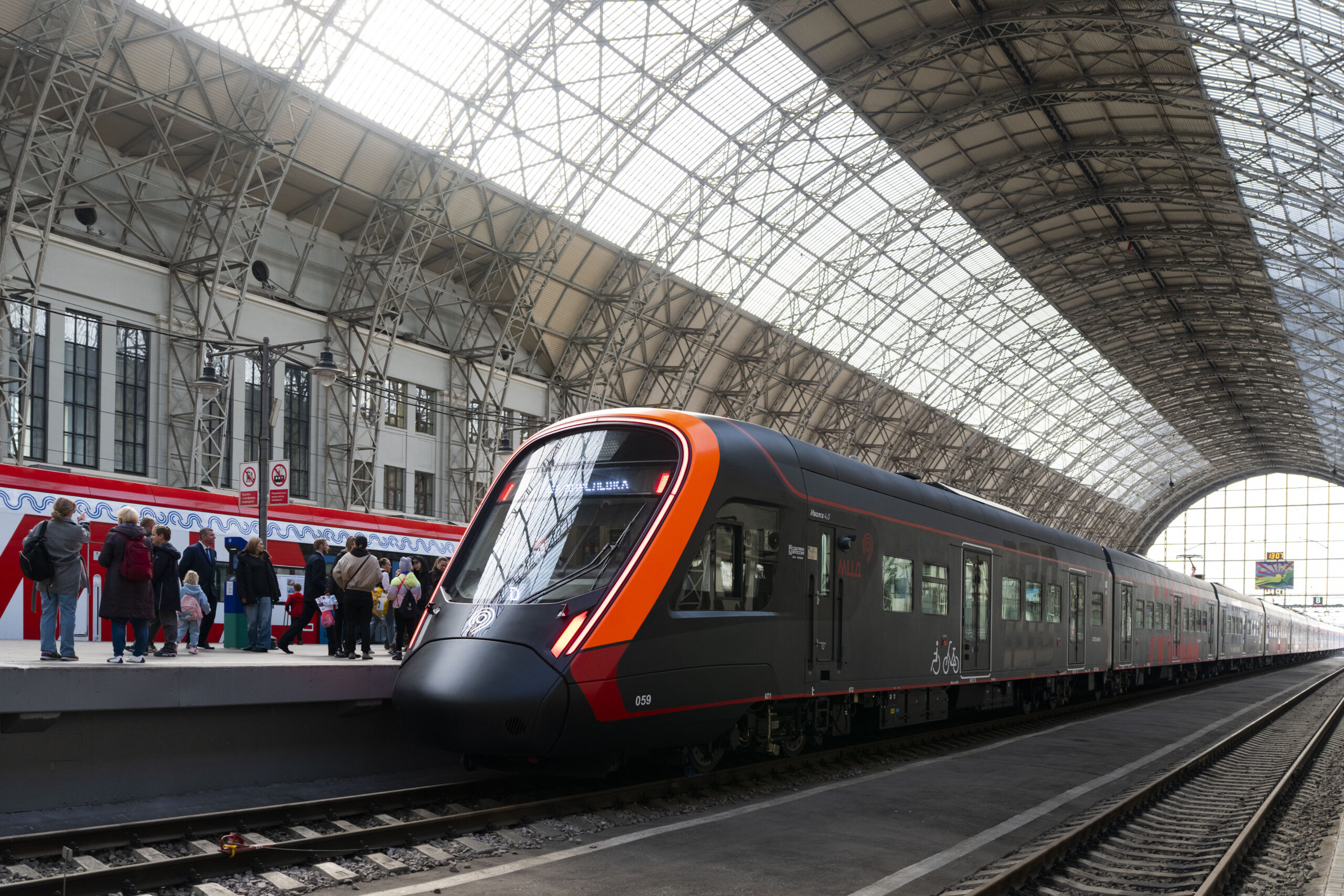
Moscow Metro – Black “Ivolga” launched on MCD-4

Translation. Region: Russian Federal

Source: Moscow Metro Black “Ivolga” launched on MCD-4

TMH JSC, TVZ, and CPPK launched the 100th Ivolga 4.0 in an exclusive livery.


The black Ivolga was launched on MCD-4.

The matte black body with bright red "MCD" letters and a shiny "100" makes the train a true metropolitan art object. Inside, passengers enjoy maximum comfort, complemented by the mint-colored interior.

It is emotion, style and a symbol of how Moscow transport sets the standards for the future.

"The 100th Ivolga is a special train. Passengers have been eagerly awaiting its arrival, and today it hit the roads. It is a symbol of the development of Moscow transport, a combination of engineering, design, and passenger comfort. By deploying the black anniversary Ivolga on MCD-4, Moscow has once again set an example of what modern urban transport should be. We are developing the MCD on the instructions of Moscow Mayor Sergei Sobyanin," said Maxim Liksutov.

Financial news: On October 6, 2025, UK FRT LLC will hold a deposit auction.

Translation. Region: Russian Federal

Source: Moscow Exchange – Moscow Exchange –

An important disclaimer is at the bottom of this article.

Please note: This information is raw content obtained directly from the source. It represents an accurate account of the source's assertions and does not necessarily reflect the position of MIL-OSI or its clients.

CategoriesEconomics, Mil-SOSI, Moscow, Russia, Russian Economy, Russian Federal, Russian Language, Moscow Exchange, University life /

Post Navigation

Archives

Parameters
Date of the deposit auction October 6, 2025
Placement currency Rub
Maximum amount of funds placed (in placement currency) 2,800,000,000
Accommodation period, days 63
Date of deposit October 6, 2025
Refund date December 8, 2025
Minimum interest rate for placement, % per annum 17
Conditions of imprisonment, urgent or special Urgent
Minimum amount of funds placed per application (in placement currency) 2,800,000,000
Maximum number of applications from one Participant, pcs. 1
Auction form, open or closed Open
Basis of the Treaty General Agreement
Schedule (Moscow time)
Preliminary applications from 12:00 to 12:10
Applications in competition mode from 12:10 to 12:15
Setting a cut-off percentage or declaring the auction invalid until 12:25
Additional terms and conditions

Financial news: 06.10.2025, 11-17 (Moscow time) the values of the upper limit of the price corridor and the range of market risk assessment for the security RU000A0JWHU2 (RZhD BO-17) were changed.

Translation. Region: Russian Federal

Source: Moscow Exchange – Moscow Exchange –

An important disclaimer is at the bottom of this article.

October 6, 2025, 11:17 AM

In accordance with the Methodology for determining the risk parameters of the stock market and the deposit market of PJSC Moscow Exchange by the National Credit Center (JSC) on October 6, 2025, 11:17 AM (Moscow time), the values of the upper limit of the price corridor (up to 96.42) and the range of market risk assessment (up to 1078.55 rubles, equivalent to a rate of 20.0%) for the security RU000A0JWHU2 (RZhD BO-17) were changed.

Please note: This information is raw content obtained directly from the source. It represents an accurate account of the source's assertions and does not necessarily reflect the position of MIL-OSI or its clients.

Financial news: On October 6, 2025, the Territorial Development Fund will hold a deposit auction.

Translation. Region: Russian Federal

Source: Moscow Exchange – Moscow Exchange –

An important disclaimer is at the bottom of this article.

Please note: This information is raw content obtained directly from the source. It represents an accurate account of the source's assertions and does not necessarily reflect the position of MIL-OSI or its clients.

CategoriesEconomics, Mil-SOSI, Moscow, Russia, Russian Economy, Russian Federal, Russian Language, Moscow Exchange, University life /

Post Navigation

Archives

Parameters
Date of the deposit auction October 6, 2025
Placement currency Rub
Maximum amount of funds placed (in placement currency) 650,000,000
Accommodation period, days 22
Date of deposit October 6, 2025
Refund date October 28, 2025
Minimum interest rate for placement, % per annum 17
Conditions of imprisonment, urgent or special Urgent
Minimum amount of funds placed per application (in placement currency) 650,000,000
Maximum number of applications from one Participant, pcs. 1
Auction form, open or closed Open
Basis of the Treaty General Agreement
Schedule (Moscow time)
Preliminary applications from 12:30 to 12:40
Applications in competition mode from 12:40 to 12:45
Setting a cut-off percentage or declaring the auction invalid until 12:55
Additional terms and conditions

Financial news: 145 corporate bond issues were placed on the Moscow Exchange in September.

Translation. Region: Russian Federal

Source: Moscow Exchange – Moscow Exchange –

An important disclaimer is at the bottom of this article.

The total volume of bond trading, including placements and secondary circulation, on the Moscow Exchange in September 2025 amounted to 3.4 trillion rubles, excluding overnight bonds (2.2 trillion rubles in August 2024).

Primary market

The total volume of bond placements and buybacks on the Moscow Exchange in September 2025 amounted to 1.77 trillion rubles, including one-day bonds worth 293 billion rubles.

In September, 145 corporate bond issues (excluding overnight ones) from 73 issuers with a total volume of 1.08 trillion rubles were placed on the Moscow Exchange.

Secondary auctions

The total volume of secondary bond trading on the Moscow Exchange in September 2025 amounted to 1.95 trillion rubles (798 billion rubles in September 2024).

The total volume of retail transactions on the Moscow Exchange bond market amounted to 591.3 billion rubles (257 billion rubles in September 2024). Their share of total bond trading volume was 29.3%.

The volume of over-the-counter transactions with the central counterparty (OTC with the CCP) with bonds at the end of the month amounted to 319.9 billion rubles (120.3 billion rubles in September 2024).

Moscow Exchange is Russia's largest exchange and the only multifunctional platform for trading stocks, bonds, derivatives, currencies, money market instruments, and commodities. The Moscow Exchange Group includes a central depository and a clearing center that acts as a central counterparty in the markets, enabling Moscow Exchange to provide its clients with a full range of trading and post-trading services.

Contact information for media: 7 (495) 363-3232Pr@moex.kom

Please note: This information is raw content obtained directly from the source. It represents an accurate account of the source's assertions and does not necessarily reflect the position of MIL-OSI or its clients.

Financial news: 06.10.2025, 12-11 (Moscow time) the values of the upper limit of the price corridor and the range of market risk assessment for the security RU000A109SK6 (MTS 1P-27) were changed.

Translation. Region: Russian Federal

Source: Moscow Exchange – Moscow Exchange –

An important disclaimer is at the bottom of this article.

October 6, 2025, 12:11 PM

In accordance with the Methodology for determining the risk parameters of the stock market and the deposit market of PJSC Moscow Exchange by the NCC (JSC) on October 6, 2025, 12:11 (Moscow time), the values of the upper limit of the price corridor (up to 109.33) and the range of market risk assessment (up to 1194.1 rubles, equivalent to a rate of 12.5%) for security RU000A109SK6 (MTS 1P-27) were changed.

Please note: This information is raw content obtained directly from the source. It represents an accurate account of the source's assertions and does not necessarily reflect the position of MIL-OSI or its clients.