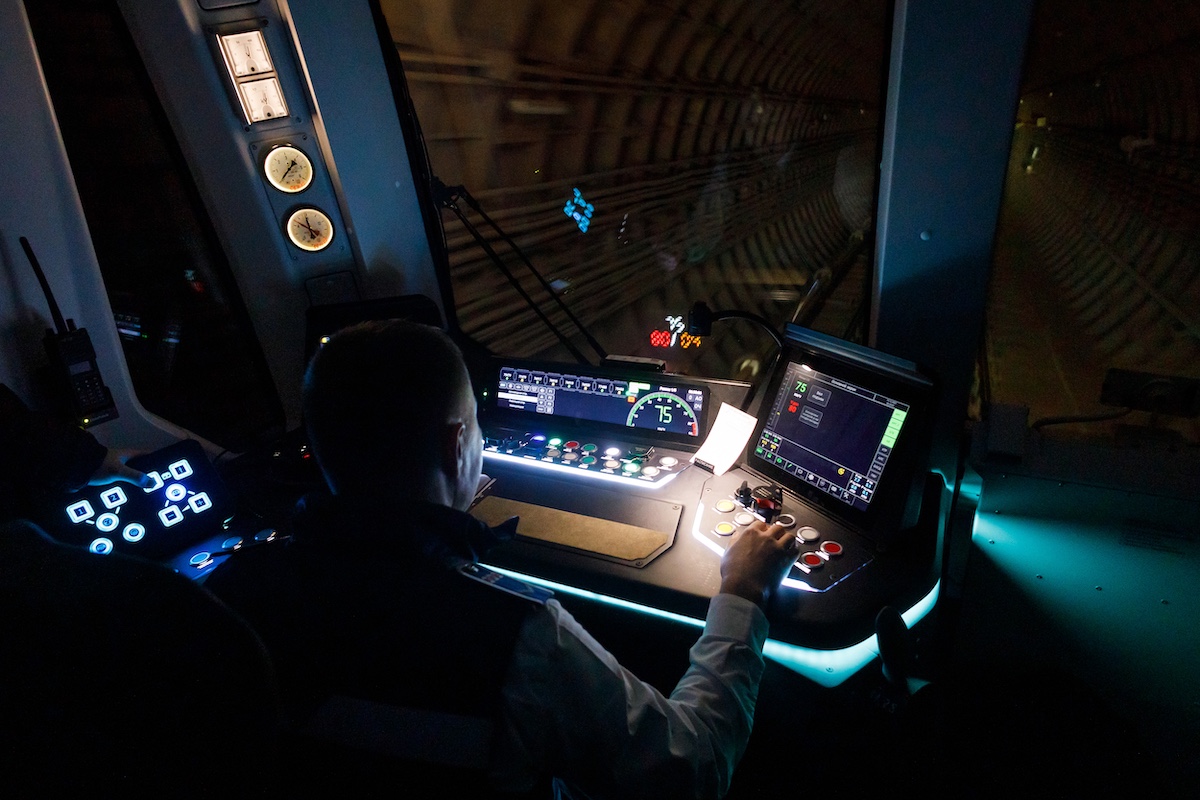
Test runs of the new "Moscow-2026" train have begun in the capital's metro.

Translation. Region: Russian Federation –

Metrovagonmash (part of TMH JSC) recently completed assembly of Russia's most modern train, the "Moscow-2026." The train underwent testing of all systems at the manufacturer's plant and additional checks at the depot.

Currently, it is undergoing a test run without passengers—the final stage before launch. During this run, metro specialists will analyze every detail, after which the train will enter service and begin full operation.

The test run consists of two stages. The train must travel smoothly on metro rails for: 1) 15 km and 2) 300 km.

During this time, dozens of parameters are checked, including:

1) safety and reliability of train operation on the line;

2) smooth ride on rails; 3) lighting and vibration in the cabin;

4) braking distance and much more.

In addition, all new components will undergo separate testing. If any deviations are discovered during the testing, they will be corrected and testing will begin again.

"Moscow Mayor Sergei Sobyanin has decided to purchase 40 additional cars, which will be deployed this year on one of the most popular lines of the Moscow metro—the Zamoskvoretskaya Line. The "Moscow-2026" trains are the most modern Russian trains, manufactured from domestically produced components. Over 700 new cars are planned for delivery over the next two years, which will allow us to complete the upgrade of trains on the Zamoskvoretskaya Line. Currently, over 50% of the rolling stock on this line is of the new generation," noted Maxim Liksutov.

Moscow shared its experience in developing an intelligent transport system with its colleagues from Mexico City.

Translation. Region: Russian Federation –

Moscow continues to strengthen international cooperation in urban transport. Together with the Moscow Government University, the Department of Transport organized an intensive 10-day training course for specialists from the Mexico City Mobility Secretariat. The program combined theory, practice, and familiarization with key urban transport infrastructure.

During their training, Mexican specialists:

We studied the operation of one of the world's largest photo and video recording systems. We learned about modern solutions for managing traffic in the metropolis. We learned how Moscow uses intelligent approaches to installing and configuring traffic lights. We visited the Mitino electric bus depot, the Unified Dispatch Center, the TsODD Situation Center, and the Autonomous Vehicle Research and Development Center.

Moscow regularly conducts similar training programs. Previously, they have involved transport agency employees from Brazil, Iraq, Kyrgyzstan, and Uzbekistan.

"At the request of Moscow Mayor Sergei Sobyanin, we share our experience implementing advanced transport solutions with colleagues from other countries. We regularly conduct training for specialists from transport departments in foreign cities. In November, a delegation from the Secretariat of Mobility of Mexico City received a detailed overview of the development of the intelligent transport system in the capital," noted Maxim Liksutov.

Moscow celebrates six years of the Moscow Central Diameters: the next-generation railway network continues to develop.

Translation. Region: Russian Federation –

Six years ago, in November 2019, a new era of rail transport began in Moscow with the launch of the first two Moscow Central Diameters (MCD-1 and MCD-2). This launch marked a key step toward creating a modern and convenient above-ground metro system.

Before the introduction of the diameters, commuter trains were considered commuter transport with infrequent services, outdated platforms, and poor comfort. The MCDs changed this: today, four diameters operate in the capital region, connecting 137 stations. The total length of the lines exceeds 300 kilometers.

The MCD network is seamlessly integrated into Moscow's unified transport system: passengers have access to over 100 transfers to the metro, the Moscow Central Circle, and other diameters. Unified fares make MCD travel part of the city's transport infrastructure.

Modern Russian-made trains provide a comfortable and convenient travel experience. During the first year of operation, the rolling stock on the first two diameters was completely renewed, and in 2025, the MCD-3 and MCD-4 will be updated.

According to Maxim Liksutov, Deputy Mayor of Moscow for Transport and Industry, the Moscow Central Diameters (MCDs) are becoming an increasingly popular mode of transport every year. Since their inception, passengers have made nearly 1.6 billion trips, with up to 500,000 trips made daily. Today, the MCDs have become a fully-fledged surface metro and an alternative to other modes of public transport.

The network's development continues. Modern passenger services are being introduced at the diameters, stations are being built and reconstructed, new, comfortable city terminals are being created, and infrastructure is being updated. Currently, 54 MCD stations are operating in the city, with projects underway at Petrovsko-Razumovskaya, Serp i Molot, Tsaritsyno, Begovaya, and Moscow-City stations.

The XIX International Forum and Exhibition "Transport of Russia" has started!

Translation. Region: Russian Federation –

From November 18th to 20th, we'll be presenting the best solutions from the Moscow Government. The venue brings together government officials and executives from leading Russian companies. Visitors to the exhibition will learn:

On the implementation of innovative transport. Guests will see how Russia's first fully driverless tram "sees" obstacles along the route: people, stops, traffic lights. Since May 2024, it has traveled over 18,000 km across the city without a single traffic violation. They will also discuss biometric payment and next-generation turnstiles, which will increase metro station capacity by 40%. They will also discuss smart traffic management systems. For example, how the integrated traffic management system (AIS KSODD) works for digital design. They will also discuss traffic management projects that have helped optimize parking spaces and create comfortable pedestrian access to major sites. All of this is being developed by specialists at the MosTransProekt Research Institute. They will also learn how transport professions are trained—from train driver to top manager—at the Corporate University of the Transport Complex. They will also learn about the capabilities of the Alexander chatbot, which answers citizens' questions 24/7 about the metro, the Moscow Central Circle (MCC), the Moscow Central Diameters (MCD), transport services, and much more.

This is just a part of the transport innovations that we will show.

"Following Moscow Mayor Sergei Sobyanin's instructions, we are actively collaborating with the regions of our country. Some projects are already being used outside the capital. This year, at the exhibition and forum, we will showcase the latest transport projects and digital services in fare collection and parking, demonstrate the operation of driverless vehicles, and demonstrate the best traffic management solutions. We will share our implementation experience and the benefits of these innovations. All of this will help us together create the future of national transport," said Maxim Liksutov.

The events take place at Gostiny Dvor in Moscow.

Moscow's first tram diameter, T1, is rapidly gaining popularity.

Translation. Region: Russian Federation –

T1 is a new tram route from Metrogorodok to Universitet metro station, providing fast and comfortable travel between eastern and southwestern Moscow via the city center. It operates at the same level as the overground metro.

Maxim Liksutov reported that trams have completed over 500 trips on the T1 route and traveled over 13,000 km. The T1 route is 27 km long, making it the longest urban diametrical tram route in the world. T1 connects 13 Moscow districts from east to southwest, four central railway stations, and 24 metro stations, as well as the Moscow Central Circle (MCC) and Moscow Central Diameters (MCD).

The first autonomous "Lvenok-Moscow" trams in Russia operate on this route; they travel a 2.1-kilometer stretch along Academician Sakharov Avenue without connecting to the overhead power line.

"Moscow Mayor Sergei Sobyanin recently opened the longest urban diametrical tram route in the world. The first line of the MTD has already proven its convenience and popularity. Passengers have taken over 100,000 trips on it. We continue to develop environmentally friendly and innovative transportation in the capital," added Maxim Liksutov.

Moscow Metro: The Yaroslavl line will become faster and more comfortable: new Ivolga trains have arrived on the Yaroslavl line.

Translation. Region: Russian Federation –

Source: Moscow Metro

Moscow, November 9 – By the end of the year, the fleet of modern Ivolga 4.0 trains on the Yaroslavl line will be expanded to 15 units. This is part of a large-scale rolling stock renewal program being implemented jointly with the Central Suburban Passenger Company (CPPK) and Russian Railways.


The Yaroslavl route will become faster and more comfortable: new Ivolga trains have appeared on the Yaroslavl route.

Comfort, speed and safety:

• The first “Ivolga 4.0” have already hit the roads this year.

• By 2030, it is planned to purchase 92 new trains.

• The average age of the train fleet will be reduced by 5 times, to 3.5 years.

• The new trains are 20% more spacious, provide 15% faster and more comfortable boarding, and have a 45% wider aisle, which is especially convenient during rush hours.

• The upgrade will allow the transportation of more than 300 thousand passengers daily.

Implementation stages:

• To launch new trains, a comprehensive check and adjustment of all systems is carried out.

• Particular attention is paid to the training of drivers, who undergo additional training.

• A new division of the Tver Carriage Works has been opened in Pushkino to monitor the technical condition of trains and carry out routine maintenance.

Comprehensive development of the direction:

• Additional routes were built from Moscow to Pushkino, which reduced train waiting times by a third.

• A transport hub was built in Rostokino for convenient transfer from the Yaroslavl direction to the Moscow Central Circle.

"The upgrade of the Yaroslavl line will allow even more residents and visitors to the capital to use fast and comfortable transportation," noted the Moscow Transport press service.

A new program dedicated to the unity of the peoples of Russia was presented at the Matryoshka Moscow Festival.

Translation. Region: Russian Federation –

Source: Moscow Metro

November 4, Moscow. On National Unity Day, the "Matryoshka of Moscow" media installation presented an updated program dedicated to the diversity and uniqueness of Russia's peoples.

That evening, residents and visitors to the capital enjoyed a unique multimedia show, unparalleled anywhere in the world. According to Maxim Liksutov, Deputy Mayor of Moscow for Transport, over 30 new animated scenes with 3D graphics were prepared for visitors to Zaryadye Park, reflecting the natural and cultural riches of our country.

Recognizable symbols of Russia came to life on huge screens:

🔹 Gzhel-style owl🔹 Arctic polar bears🔹 the bountiful harvest of the southern regions🔹 the majestic mountain peaks of the Caucasus🔹 Yakut bone figurine – a talisman of the North

For the first time, the "Matryoshka of Moscow" was presented in images symbolizing the unity and identity of the peoples of Russia.

"The innovative 'Matryoshka of Moscow' attraction is unique in the world. It's not just a tourist attraction, but a new platform for digital art. Its key feature is a unique kinetic installation that changes shape every 1-2 seconds. At the behest of Moscow Mayor Sergei Sobyanin, the technology was implemented by Moscow engineers and designers. Moscow specialists spent several months creating a multimedia performance that is unparalleled anywhere in the world. Each element was hand-drawn to showcase Russia's natural and cultural riches—from the Far North to the Caucasus," said Maxim Liksutov.

The new program emphasizes the idea of a united Russia, where culture, technology, and art come together to create a modern image of a country that values traditions and is inspired by the future.

The Moscow Metro has approved the architectural concept for the Klenovy Bulvar station on the Biryulyovskaya Line.

Translation. Region: Russian Federation –

Moscow metro

The Moscow Metro has approved the architectural concept for the Klenovy Bulvar station on the Biryulyovskaya Line.

Its appearance will echo that of the nearby Kolomenskoye Museum-Reserve.

The dominant design element will be arches, positioned to create continuous perspectives throughout the entire ensemble. The composition will achieve a sense of unity and openness.

The station's name will be reflected in its decoration. For example, aluminum maple leaves will be laid on the track walls, and a similar pattern will appear on the floors in the vestibules.

Construction workers are currently erecting the enclosing structures at the future station site, conducting excavation work, and constructing foundation pit supports. Construction is underway on the right-hand tunnel between Dream Island and Klenovy Bulvar.

The Biryulyovskaya Line will include 10 stations. Completion of its first section, from ZIL to Kuryanovo, is scheduled for 2028.

New generation turnstiles will appear on Moscow transport.

Translation. Region: Russian Federation –

Maxim Liksutov announced that updated access control equipment will be installed at 25 metro stations next year.

Main advantages:

The new turnstiles were designed and manufactured in Moscow. The readers are intuitively positioned to allow for instant payment. All turnstiles are enabled for biometric payment, and facial recognition cameras are seamlessly integrated into the design. Colored backlighting indicates whether the fare has been processed, and vibration feedback helps visually impaired passengers easily understand the transaction status.

"According to Moscow Mayor Sergei Sobyanin's instructions, more than 4,500 new-generation turnstiles will be installed at metro stations, the Moscow Central Circle (MCC), and the Moscow Central Diameters (MCD) by the end of 2031. Their ergonomic design will maximize the use of vestibule space. The updated equipment will increase station capacity by 40%. Thanks to Russian microelectronics, the new turnstiles will operate even faster, increasing passenger throughput," added Maxim Liksutov.

The assembly of new Moscow-2026 trains has begun at the TMH JSC enterprise.

Translation. Region: Russian Federation –

Earlier, Moscow Mayor Sergei Sobyanin announced that the capital's metro would continue a large-scale upgrade of its rolling stock.

The first "Moscow-2026" train will be assembled by the end of the year. It will then begin testing on the Moscow metro infrastructure.

The new trains will retain the key advantages of the Moscow-2024:

Wide doors and inter-carriage walkways. Modern climate control systems. Adaptive lighting and multiple screens. USB and Type-C charging ports. Interior lighting in the same color as the line. And much more.

At the same time, the Moscow-2026 will feature partially updated plastic interior elements, glass on the handrails of the entrance area, the housing of the rear-view camera, and futuristic lighting at the head of the trains.

"The Moscow Metro is the capital's main transportation system. On weekdays, it carries over 8 million passengers. Ensuring passenger comfort and safety is our priority. In accordance with Moscow Mayor Sergei Sobyanin's instructions, we are continuing to upgrade the Moscow Metro's rolling stock. Currently, 79% of trains are new. We expect this figure to reach 90% by 2030. Furthermore, by the end of 2026, we plan to fully complete the upgrade of the Zamoskvoretskaya Line train fleet. To this end, over 350 modern "Moscow-2026" series cars will be delivered to the metro next year. Over the next two years, over 700 new cars will be delivered," said Maxim Liksutov.