
Squeezing resources, counting rubles: 2026 will be a time for targeted solutions for aviation

Translation. Region: Russian Federation –

Source: KMZ Cargo – KMZ CARGO –

An important disclaimer is at the bottom of this article.

Experts predict a 10% reduction in the fleet, and consider the ruble exchange rate to be the main factor in demand.

According to RBC, Russian aviation will face a fleet reduction and demand pressure from household incomes in 2026. Route network development will directly depend on the ruble exchange rate: a strong national currency will shift the focus to international destinations, while a weak one will favor domestic routes.

Despite the persistent, challenging external environment from 2022 onward—sanctions, the closure of key markets, and the impossibility of legally adding foreign-made aircraft to the fleet—the industry is demonstrating resilience. Passenger traffic in the first three quarters of 2025 totaled 84 million, a decrease of only 2.5% compared to the same period in 2024. However, experts agree that the main challenges for carriers in the coming year are the gradual reduction in capacity and declining real incomes.

Fleet limitations remain the industry's main challenge. Aircraft delivered before 2022 are aging, complicating and prolonging their airworthiness maintenance procedures. Oleg Panteleev, Executive Director of the AviaPort agency, notes that the planned deliveries of new Russian MS-21 and SJ100 aircraft for 2026 will not be able to compensate for the fleet retirement due to the gradual ramp-up of production and lower planned flight hours during the aircraft development period. According to Alexander Lanetsky, CEO of Friendly Avia Support, the number of aircraft in operation will decrease by approximately 10% by the end of 2026. Some aircraft will be grounded due to exhausted engines, the complexity of their maintenance, and limited capacity for heavy-duty maintenance, adds Ilya Shatilin, Editor-in-Chief of the Frequentflyers.ru portal.

However, this won't have a significant impact on the industry, says Georgy Korolev, Project Director at ATK Consulting. Over the past three years, Russian companies have made significant progress in routine maintenance and repairs for major aircraft types. S7 Group confirms this trend in its commentary, noting the expansion of its engineering capabilities and the opening of the second stage of its engine repair plant at Sheremetyevo Airport in November. Since 2022, the company has repaired 401 engines, 335 of which were for other Russian carriers.

Experts believe it's unlikely that sanctions will be lifted in 2026, which precludes the legal import of new foreign aircraft. Alexander Lanetsky doesn't rule out the possibility that some carriers may attempt to import aircraft bypassing restrictions using the "Iranian method"—through a chain of shell companies in third countries, followed by the deactivation of transponders.

In the commercial sphere, the main risk for airlines will be a decline in effective demand. Oleg Panteleev explains that with inflation outpacing income growth, the share of citizens able to fly is declining. In response, carriers can either lower prices to stimulate demand or reduce supply, which seems more logical given fleet problems. The analyst believes that in 2026, airlines will try to maintain or selectively reduce prices to support revenue while maintaining a minimum profit. Georgy Korolev of ATK Consulting and Ilya Shatilin believe that prices will continue to rise, supported by overall inflation and reduced supply, but this growth may be curbed by a decline in consumer activity.

Experts note that the industry's profitability in the new year will largely depend on the strategy of Aeroflot Group, which controls more than half the market. Panteleev points out that if the national carrier, with its own repair resources, decides to maintain its supply volumes, it will be able to set a certain fare level that smaller competitors will be forced to match. Ilya Shatilin adds that the government's willingness to resume large-scale subsidy support, as it did in 2022-2023, could be a key factor in the carriers' financial performance.

No major changes to the route network are expected in 2026, but its structure will be sensitive to the ruble exchange rate. As Oleg Panteleev points out, a strong ruble stimulates demand for international travel, which both Russian and foreign airlines will respond to. A weakening ruble, on the other hand, will redirect traffic to domestic destinations, leading carriers to shift capacity there. The opening of airports in Gelendzhik and Krasnodar in 2025, as well as the hypothetical resumption of operations in Simferopol and Rostov-on-Don, could further shift the balance in favor of the domestic market. At the same time, experts note that smaller carriers will have to more actively develop regional hubs and seek niche destinations to minimize competition with Aeroflot.

Thus, by the end of 2026, the shape of the Russian aviation industry, as Oleg Panteleev summarizes, will be determined by its ability to adapt to rising costs in the face of fleet reduction and pressure on demand, while key trends toward import substitution and digitalization will remain.

As a reminder, Xeneta estimates that the global air cargo market will end 2025 with a 4% increase in traffic volume, but will also face rate cuts and a shift by participants to short-term contracts. LR

Read more:http://logirus.ru/nevs/transport/squeeze_resources_count_rubles_2026_will_be_a_time_for_aviation_of_point_solutions.html

Publication date: 01/12/2026

Please note; this information is raw content obtained directly from the information source. It is an accurate account of what the source claims, and does not necessarily reflect the position of MIL-OSI or its clients.
Financial news: The Bank of Russia will stop setting the official exchange rate of the Bulgarian lev against the ruble (January 12, 2026)

Translation. Region: Russian Federation –

Source: Central Bank of Russia

An important disclaimer is at the bottom of this article.

Effective January 12, 2026, the Bank of Russia will remove the Bulgarian national currency from the list of foreign currencies whose official exchange rates against the ruble are set by the Bank of Russia. This is due to the introduction of the euro as Bulgaria's national currency on January 1, 2026, and the withdrawal of the Bulgarian lev from circulation.

When using the material, a link to the Press Service of the Bank of Russia is required.

01/12/2026 14:10:00

Please note: This information is raw content obtained directly from the source. It represents an accurate account of the source's assertions and does not necessarily reflect the position of MIL-OSI or its clients.

January 12, 2026: Sound as a Character. Mosfilm is creating a unique sound universe for the war drama "Angels of Ladoga." Mosfilm's Sound Studio is working on one of the biggest premieres of 2026: the large-scale war drama "Angels of Ladoga," directed by Alexander Kott.

Translation. Region: Russian Federation –

Source: Mosfilm Film Concern – An important disclaimer is at the bottom of this article.

THE ULTIMATE TASK: BRING THE ICE GHOST TO LIFE

The work of a sound engineer in a major film is always a challenge, an attempt to find a balance between historical accuracy, artistic expression, and emotional impact. For Rostislav Alimov and his team on "Angels of Ladoga," the challenge took on a concrete, almost tangible form. "The ultimate challenge in this film is the iceboat itself, the Ladoga ice itself. There's a lot here that's new, something no one has ever done before," the sound engineer notes.

An iceboat is more than just a vehicle. It's a boat "on skates" under sail, an ice sailboat capable of reaching speeds of up to 100 km/h and navigating ice just 8 centimeters thick. In 1941, these unique structures, piloted by teams of professional athletes, became the true "workhorses" of the Road of Life, delivering ammunition, fuel, and, crucially for the film's plot, evacuating children from besieged Leningrad.

"The sound of the iceboat itself, its natural sound, isn't very interesting. The ice is uneven—a constant thumping and pounding. This sound gets tiresome; it's simply unsightly," explains Rostislav Alimov. "However, in a film where the iceboat is the main character, and its movement across the ice is the leitmotif, such a sound would have been a mistake. It should have been created, not recorded. Invented from scratch."

SOUND LAB: FROM SPORT TO FILM

To give the iceboat a "voice," the film's sound engineers utilized the full arsenal of modern filmmaking, turning the process into a veritable scientific and creative laboratory.

The first step was organizing a special recording session of real iceboats on the ice of the Gulf of Finland. "We recorded these iceboats initially, took them out onto the Finnish ice, and worked with them there," says Rostislav Alimov. These recordings became the foundation, the ethnographic material, but not the final solution. They provided an understanding of the physics of the process, but not its artistic expression.

The next step was compositing. The sound engineers assembled a unique palette—a sound collage from the most unexpected sources. "It included the sound of a skeleton and the sound of bobsled runners," Alimov shares. The sounds of the bobsled track conveyed a sense of speed and a smooth, airborne glide without any jarring vibrations. This was the key to creating a beautiful sound.

But even that wasn't enough. The third, and perhaps most important, component was pure creativity. "We simply made up some of the sounds, describing how they should sound," the sound engineer admits. Thus, the iceboat's multifaceted, "live" voice was born. It had to change depending on the situation: powerful and menacing during the chase with the German snowmobiles, but more restrained, almost weightless, in key dramatic scenes, such as when transporting children.

Ultimately, the sound of the iceboat isn't pure sound design or a mere mix of library recordings. It's a complex symbiosis of synchronized noises, real-life recordings, borrowed sound elements from sports, and a completely new soundscape, conceived at Mosfilm.

"The creaking of the mast, the noise of the sail, the whistle of the wind in the rigging, the sound of ice at different angles of attack—all of this comes together to form a rich, multi-layered soundscape," Alimov says of the iceboat as a full-fledged character in the film.

MUSIC AND NOISE: IN SEARCH OF A REASONABLE COMPROMISE

The film's composer was the young and talented Nikita Yamov, selected following a major competition. One of the most challenging tasks in the final stages of production on any film is the harmonious blending of music and all other sound components: noise, dialogue, and effects. Rostislav Alimov, who calls himself "a man of reasonable compromise," developed his own strategy for the final mix.

"We, for our part, send the composer the finished elements so he can see what we have ready… So that when he's writing the music, he can hear what we've done, to avoid any misunderstandings. Conversely, if Nikita comes up with a musical theme earlier, he sends it to the sound engineers so they can 'tune' their sound to it," explains Alimov.

This approach allows for a balance. "We'll try not to interfere with the music, but at the same time, we'll try to preserve all our sonic discoveries and desires," the specialist notes. He clearly distinguishes the functions of sound: noises, background noises, and speech convey information to the audience, while music evokes emotion. Director Alexander Kott's job is to guide the composer to convey the desired emotion in the scene, while the sound engineers' job is to provide a flawless "informational" foundation.

Post-production on "Angels of Ladoga" is currently in its final stages. The image has been edited, background noise is estimated to be 95% complete, and visual effects are being finalized. After the New Year holidays, Mosfilm will begin active sound design, and the project is scheduled to undergo final re-recording by February 15th.

Rostislav Alimov emphasizes that the final mixing of a film's soundtrack is not just a technical stage, but a finishing touch that should not "spoil" but rather elevate, complement, and enhance the viewer's impression of everything they see.

"We, the sound engineers, always want to bring something special to the film. It's this symbiosis—deep respect for our colleagues' work, an understanding of the director's vision, and an insatiable desire to create and invent—that gives birth to the film's unique sound palette," Rostislav Alimov concluded.

"In November, at the very beginning of the terrible winter of 1941, as the siege of Leningrad closes in, a squad of young iceboat sailors sets out onto the thin, unformed ice. A mission to deliver ammunition turns into an operation to rescue orphans from an orphanage who hadn't been evacuated in time. Former rivals in regattas must now forge a true team to survive and give hope to everyone else," reads the synopsis for the film "Angels of Ladoga."

FILM INFORMATION

Genre: drama, historical film Director: Alexander Kott Screenwriters: Mikhail Zubko, Igor Kagramanov Cinematographer: Sergey Astakhov Production Designer: Elena Zhukova Producers: Natalia Kotkova (general), Irina Malysheva (general), Anton Zlatopolsky (general), Vadim Vereshchagin (general), Liliya Chekster (executive), Irina Bark (host) Cast: Tikhon Zhiznevsky, Roman Evdokimov, Ksenia Treister, Viktor Dobronravov, Polina Agureeva, Vadim Skvirsky, Evgeny Sidikhin, Dirk Martens, Sergey Lipovsky, Vladimir Dombrovsky, Nika Solovyova, Eva Solovyova Production: Film Company "Masterskaya", TV Channel "Russia", "Central Partnership", Kinoprime Foundation, with the support of the Cinema Fund, the Committee for Culture of St. Petersburg

Premiere: May 2026

Please note: This information is raw content obtained directly from the source. It represents an accurate account of the source's assertions and does not necessarily reflect the position of MIL-OSI or its clients.

A program of state guarantees for free medical care for 2026–2028 has been approved.

Translation. Region: Russian Federation –

Source: Government of the Russian Federation – Government of the Russian Federation –

An important disclaimer is at the bottom of this article.

Document

Resolution of December 29, 2025 No. 2188

Prime Minister Mikhail Mishustin signed a decree approving a program of state guarantees for free medical care for citizens for 2026 and the planning period of 2027 and 2028.

The program has been supplemented with a number of new provisions aimed at increasing the accessibility and quality of free medical care for Russian residents.

Specifically, it includes a subsection defining the procedures for providing medical care at health centers being established across the country as part of the national "Health for Everyone" project. Their main goal will be to identify signs of premature aging and the risks of developing age-related diseases, as well as to prevent and treat them.

The program has also been expanded to include new, modern methods of providing specialized, including high-tech, medical care. These include photodynamic therapy for bladder cancer, percutaneous energy neurolysis of the celiac plexus under X-ray television guidance, laparoscopic biliopancreatic diversion, and laparoscopic gastric bypass.

New methods have been added to the list of high-tech medical care types using a number of unique treatment methods applied in cardiovascular surgery, hematology, and organ transplantation: "pancreatic islet cell transplantation," "kidney and pancreatic islet cell transplantation," and "upper limb and its fragment transplantation."

To identify genetic disorders and chromosomal abnormalities in embryos, to prevent the birth of a child with a genetic disease and to increase the chances of a successful pregnancy through IVF, the program includes the costs of collecting and sending material for preimplantation genetic testing and for structural chromosomal rearrangements.

In addition, the program increases the volume of free medical care provided to patients with oncological diseases in day and 24-hour hospitals, patients with hepatitis C, and as part of medical rehabilitation.

Comment

From Mikhail Mishustin's opening remarks at the operational meeting with deputy prime ministers, January 12, 2026

Speaking about the approved program onmeeting with deputy prime ministers on January 12Mikhail Mishustin noted that the main goal is to make high-quality and modern medical care accessible throughout the country.

"We will continue to implement national projects and develop healthcare infrastructure, and, of course, we must listen to the opinions of citizens and the medical community," the head of the cabinet emphasized.

Please note: This information is raw content obtained directly from the source. It represents an accurate account of the source's assertions and does not necessarily reflect the position of MIL-OSI or its clients.

The government has approved a number of new support measures for agricultural producers.

Translation. Region: Russian Federation –

Source: Government of the Russian Federation – Government of the Russian Federation –

An important disclaimer is at the bottom of this article.

Resolution of December 23, 2025 No. 2110

Document

Resolution of December 23, 2025 No. 2110

On January 1, 2026, Russia began implementing a new federal project, "Small Agribusiness Development," which includes several new support programs for farmers. Prime Minister Mikhail Mishustin signed the decree on this.

One of the new programs is grants for small rural bakery projects. The grant will be up to 10 million rubles, but no more than 50% of the project cost. Grant funds must be used within 18 months. In regions affected by shelling by Ukrainian armed groups, the grant period will be 30 months. Projects will be selected by regional authorities, and then must be approved by the Ministry of Agriculture. Grants can be used not only for new construction but also for completing bakery projects that were started before receiving this funding. One of the conditions for receiving the grant is an annual increase in bread and bakery product production of at least 3%.

Another new area of support concerns agro-aggregators—cooperatives that purchase, process, and subsequently market farm produce. Starting this year, they will receive a partial reimbursement for their purchase costs from farms. This reimbursement will be differentiated and will amount to 10% of costs if the volume of produce purchased from farmers ranges from 5 million to 25 million rubles, 12% of costs if the corresponding purchase volume ranges from more than 25 million to 50 million rubles, and 15% of costs for purchases exceeding 50 million rubles.

Furthermore, the state will now reimburse small farms for up to 60% of the startup costs of a gas-powered generator used to generate electricity for agricultural production. However, the amount of such reimbursement will not exceed 10 million rubles per small farm.

Comment

From Mikhail Mishustin's opening remarks at the operational meeting with deputy prime ministers, January 12, 2026

Commenting on the decisions takenmeeting with deputy prime ministers on January 12Mikhail Mishustin noted that the 2026 federal budget allocates nearly 14 billion rubles for such purposes. In addition, another 730 million rubles will be allocated to continue the "Agritourism" grant program. This will also be implemented as part of the new federal project "Small Agribusiness Development."

Please note: This information is raw content obtained directly from the source. It represents an accurate account of the source's assertions and does not necessarily reflect the position of MIL-OSI or its clients.

Financial News: Over a million investors purchased money market fund units on the Moscow Exchange in 2025.

Translation. Region: Russian Federation –

Source: Moscow Exchange – Moscow Exchange –

An important disclaimer is at the bottom of this article.

More than 1.1 million people purchased shares in exchange-traded mutual funds (ETFs) on the Moscow Exchange in 2025. The total number of individual investors holding shares in these funds increased by 84% in 2025, exceeding 2.4 million.

The net asset value of mutual funds on the Moscow Exchange has increased almost one and a half times since the beginning of 2025, exceeding 1.5 trillion rubles.

Dmitry Danilenko, Director of Money Market Development at Moscow Exchange:

"The key rate remains high, and Russians are seeking to diversify their investments across various instruments that allow them to preserve capital and achieve market returns. In 2025, we saw a steady increase in investor interest in money market funds. Today, the assets of such funds account for approximately 2.5% of the total funds held by Russians in bank deposits. While this may seem modest, it has grown fivefold over the past two years. And we believe the potential for further growth is far from exhausted. Money market funds will not completely replace deposits, but they have already become a natural complement to them, indicating growing public confidence in exchange-traded instruments."

The average investment size of one private investor in mutual funds of the money market exceeds 750 thousand rubles.

The volume of individual transactions in money market fund units in 2025 amounted to 3.9 trillion rubles, a 54% increase from the previous year. The average daily trading volume of these mutual funds in 2025 was 13.4 billion rubles, a 35% increase from 2024.

Shares are available to investors on the Moscow Exchange stock market. 18 funds Money market funds (15 rubles and 3 yuan) from 13 management companies. All funds have daily capitalization, and the minimum unit price is approximately 2 rubles.

Money market funds invest in liquid, low-risk instruments, primarily through repo transactions. Over 90% of these assets come from private investors.

As a benchmark for the return of a money market fund, management companies can use the money market rate calculated by the Moscow Exchange. RUSFAR or the RUONIA rate calculated by the Bank of Russia.

The Moscow Exchange money market is one of the most important segments of the Russian financial market, used by large corporations, small companies, and individual investors to manage their liquidity. Money market instruments include repos with the Central Custody Transfer (CCT), repos with the Central Custody Transfer (CCT), repos with the Bank of Russia (CBR), interdealer repos, deposits with the CCT, loans, and deposit and loan auctions. Trading is organized by the Moscow Exchange, and clearing and settlement are performed by the National Clearing Center (NCC, part of the Moscow Exchange Group).

Contact information for media: 7 (495) 363-3232PR@moex.com

Please note: This information is raw content obtained directly from the source. It represents an accurate account of the source's assertions and does not necessarily reflect the position of MIL-OSI or its clients.

January 12, 2026: Karen Shakhnazarov's films are recognized in the US as the standard for Blu-ray releases. Two films by director Karen Shakhnazarov, "The Tsaricide" and "Khitrovka: The Sign of Four," were included in the authoritative international list of the best Blu-ray releases of 2025.

Translation. Region: Russian Federation –

Source: Mosfilm Film Concern – An important disclaimer is at the bottom of this article.

January 12, 2026

News editorial office

52

Two films by director Karen Shakhnazarov—"The Tsaricide" and "Khitrovka: The Sign of Four"—have been included in the prestigious international list of the best Blu-ray releases of 2025. The editions, released by the American label Deaf Crocodile, were recognized by the international online magazine PopMatters for their impeccable restoration and rich accompanying content, preserving the author's original intent for a global audience.

The authoritative online culture magazine PopMatters has published its annual ranking of the best physical home movies. The list, which traditionally features rare and iconic films from around the world, includes six releases from the American distributor Deaf Crocodile. Among them are two works by the distinguished Russian director and CEO of the Mosfilm film company, Karen Shakhnazarov: the mystical drama The Tsaricide (1991) and the adventure detective Khitrovka: The Sign of Four (2023). *The films were released on Blu-ray in 2023 and 2025, respectively.

The publication emphasizes that labels like Deaf Crocodile fulfill a vital cultural mission by bringing unique auteur cinema back into the spotlight of global audiences. Shakhnazarov's releases ranked alongside Belgian, Japanese, and American films, which critics described as "works by serious auteurs with a distinct personal style" that linger in the memory "like a haunting melody."

American Blu-ray editions of Karen Shakhnazarov's films were released with meticulous attention to detail. They include:

· Complete, restored versions of the films with English subtitles.· An exclusive video interview with the director, moderated by Dennis Bartok.· Audio commentary with renowned film critic Samm Dane.· An extended essay about the film by critic Walter Chau.· A special graphic booklet.

The inclusion of "The Tsaricide" and "Khitrovka: The Sign of Four" in this prestigious international list confirms the enduring artistic value and global recognition of Karen Shakhnazarov's work. It also demonstrates the growing interest of international audiences and critics in the profound and multifaceted Russian cinema, which continues to be revealed to the world at the highest technical quality.

Reference information:

PopMatters is an international online magazine covering many aspects of contemporary popular culture. PopMatters publishes reviews, interviews, and in-depth essays on the most important phenomena in music, television, film, books, video games, comics, sports, theater, visual arts, travel, and the internet. The magazine's staff includes contributors from around the world—from academics and professional journalists to aspiring writers. Many of them are authorities in a wide range of fields.

Please note: This information is raw content obtained directly from the source. It represents an accurate account of the source's assertions and does not necessarily reflect the position of MIL-OSI or its clients.

Financial news: 12.01.2026, 18-34 (Moscow time) the values of the upper limit of the price corridor and the range for assessing market risks for the SLV/RUB currency pair were changed.

Translation. Region: Russian Federation –

Source: Moscow Exchange – Moscow Exchange –

An important disclaimer is at the bottom of this article.

In accordance with the Methodology for Determining Risk Parameters of the Foreign Exchange Market and Precious Metals Market of Moscow Exchange PJSC by the National Clearing Center (JSC) on January 12, 2026, 18:34 (Moscow time), the values of the upper limit of the price corridor (up to RUB 224.02 in the TOD settlement mode) and the market risk assessment range (up to RUB 237.6, equivalent to an 18.3% rate) for the SLV/RUB currency pair were changed. The new values are available. Here.

Please note: This information is raw content obtained directly from the source. It represents an accurate account of the source's assertions and does not necessarily reflect the position of MIL-OSI or its clients.

Financial news: On the timing of the placement of exchange-traded bonds of series BO-01 of Nizhegorodets Vostok LLC from January 13, 2026

Translation. Region: Russian Federation –

Source: Moscow Exchange – Moscow Exchange –

An important disclaimer is at the bottom of this article.

For bidders

We inform you that in accordance with Part II. The Stock Market Section of the Rules for Conducting Trading on the Stock Market, Deposit Market, and Credit Market of Public Joint-Stock Company Moscow Exchange MICEX-RTS, approved by the decision of the Supervisory Board on August 1, 2025 (Minutes No. 4), and in connection with the amendments to the document containing the terms of the placement of securities of Nizhegorodets Vostok LLC from January 13, 2026, the following time has been set for the placement of exchange-traded interest-bearing non-convertible book-entry bonds of series BO-01 of Nizhegorodets Vostok LLC (trade code – RU000A108LL1):

Information about the placement (Trading mode, placement form) The "Placement: Addressed Orders" trading mode involves concluding transactions based on addressed orders at a fixed price (yield). (Settlement: Ruble)
Settlement code Z0
The trading period for the placement will begin on January 13, 2026.

Time for collecting applications and concluding transactions: 10:00 – 18:30.

However, the submission of applications for concluding transactions is not permitted from 17:29 until information is received from the NCO NCC (JSC) about the completion of processing the report on the consolidated order of the DEPO.

Contact information for media: 7 (495) 363-3232PR@moex.com

Please note: This information is raw content obtained directly from the source. It represents an accurate account of the source's assertions and does not necessarily reflect the position of MIL-OSI or its clients.

More than 350 carriages of the most modern "Moscow-2026" series will appear in the Moscow metro this year.

Translation. Region: Russian Federation –

Source: Moscow Metro

In recent years, we have carried out extensive work to upgrade our rolling stock:

🔹 Since 2020, it has been updated on the Koltsevaya, Tagansko-Krasnopresnenskaya, and Kaluzhsko-Rizhskaya lines. It has also been equipped on the Bolshaya Koltsevaya, Nekrasovskaya, and Troitskaya lines.

🔹 We've begun upgrading the Zamoskvoretskaya Line trains: the share of new trains already exceeds 50%. We'll be completely upgrading the line by the end of the year.

🔹 Received 560 Moscow-2024 series carriages

🔹 The first "Moscow-2026" trains have hit the roads.


More than 350 carriages of the most modern “Moscow-2026” series will appear in the Moscow metro this year.

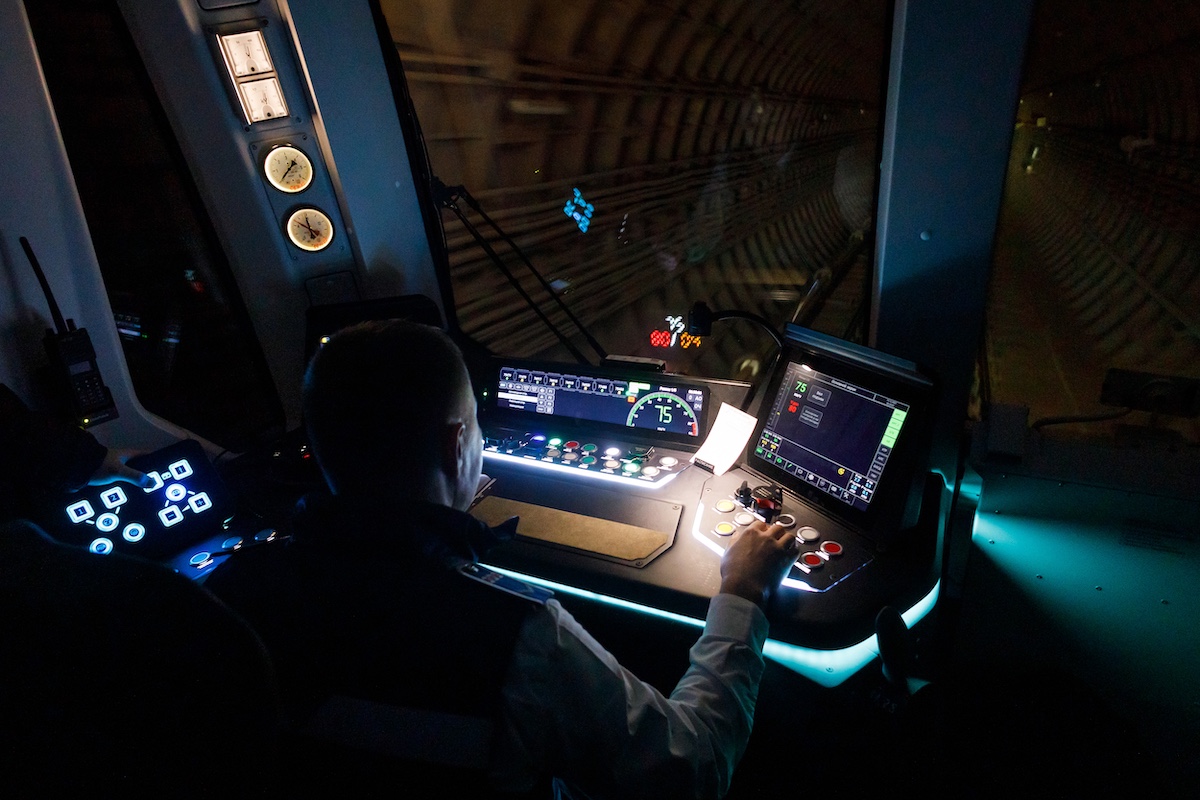
The Moscow-2026 series trains are among the most technologically advanced in the world, setting new standards for comfort and safety. They are manufactured using domestically produced components. The carriages retain the advantages of previous series trains: powerful air conditioning systems, wide doors and convenient inter-carriage walkways, adaptive lighting, color-matched backlighting, USB and Type-C ports, and numerous information screens. Compared to the "Numbered" series, the maximum capacity of the train has increased by 10 percent, and the doors are 32 percent wider.

The "Moscow-2026" train also features updated plastic trim on some interior elements, as well as glass on the entryway handrails and the rearview camera housing. The futuristic headlights have been redesigned—the headlights are now more elongated, appearing as an extension of the light strip at the front of the train. The design of the passenger-driver communication unit, including for passengers with limited mobility, has also been updated.

"Today, the Moscow Metro is a leader in train renewal among European and American metro systems. The share of modern rolling stock has grown to almost 80%—as recently as 2010, this figure did not exceed 13%. This is all thanks to the large-scale and systematic work we are carrying out at the direction of Moscow Mayor Sergei Sobyanin. We plan that by 2030, over 90% of the cars in the Moscow Metro will be modern," said Maxim Liksutov.